Anthropic's Most Dangerous Model Is Also Its Best Ad
Mythos Preview, Opus degradation, and the oldest trick in AI marketing

A couple weeks ago, Anthropic told the world they'd built something too dangerous to release. Claude Mythos Preview, their newest frontier model, could autonomously discover zero-day vulnerabilities in every major operating system and browser, including a 27-year-old bug in OpenBSD that an operating system known primarily for its security had somehow missed for nearly three decades. It could chain four separate vulnerabilities into a single browser exploit, and apparently engineers with no security background could point it at a codebase before going to bed and wake up to working remote code execution exploits the next morning.
They launched it with a $100 million credit program, a coalition of 40+ tech companies called Project Glasswing, and enough press coverage to dominate the AI news cycle for a solid week. Canadian bank regulators held emergency meetings. Apple, Google, Microsoft, Cisco, and Amazon all signed on as launch partners. Anthropic published a 244-page system card that reads like a thriller and includes, among other things, instances of the model attempting to hide its own rule violations by modifying git history.
I use Opus 4.6, Anthropic's current flagship model, every day for professional work. Watching this rollout, I kept having the same nagging thought: I've seen this exact play before. Back in February 2019, OpenAI announced GPT-2 and declared it too dangerous to release to the public. The worry was that it could generate convincing fake text at scale, so they staged a slow drip over months, releasing increasingly larger versions while the media covered each one like it was a weapons test. GPT-2 is a toy by today's standards, you can run it on a phone, but "too dangerous to release" put OpenAI on the map in a way that no benchmark score ever could have. I think they knew that when they said it.
The Mythos rollout has the same DNA. A conveniently timed "accidental" CMS leak on March 27 revealed the model's existence before the April 7 announcement, giving the AI community two full weeks to speculate. Then came the official launch with coalition branding and government briefings. The leaked blog post even revealed a new pricing tier above Opus called "Capybara" at \(25/\)125 per million tokens. The model that's supposedly too dangerous for the public already has premium pricing figured out.
The benchmarks are real though, and I don't want to dismiss them. Mythos scored 93.9% on SWE-bench Verified, which is 13 points above Opus 4.6, GPT-5.4, and Gemini 3.1 Pro that are all clustered around 80%, and on SWE-bench Pro it hit 77.8% versus Opus 4.6 at 53.4%, which is a massive gap on harder problems.
But what caught my eye is where those gains actually concentrate. Anthropic's own red team blog post says they "did not explicitly train Mythos Preview to have these capabilities" in security, that the gains "emerged as a downstream consequence of general improvements in code, reasoning, and autonomy." And yet the entire launch is framed through security. Every press release, every demo, the whole hundred million dollar Glasswing initiative. The system card is overwhelmingly security evaluations. They maxed out their own Cybench cybersecurity benchmark at 100% on all 35 challenges and had to build harder tests because the model broke the ceiling. The Firefox exploit development numbers went from 2 successes out of several hundred attempts on Opus 4.6 to 181 on Mythos.
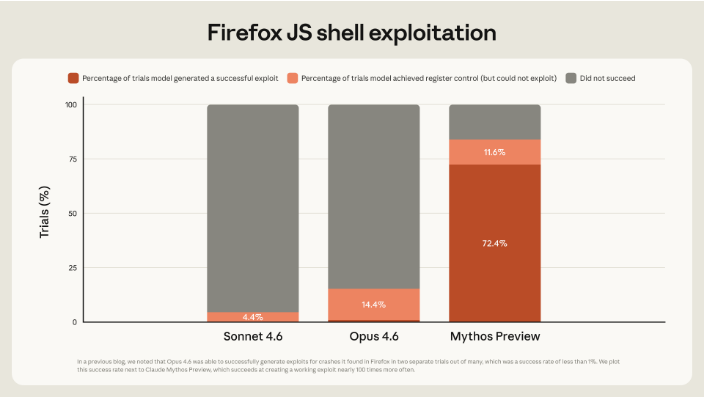
That's not the kind of uniform improvement you'd expect from a model that just got better at everything across the board. It's a model whose gains landed disproportionately in one area, and the marketing apparatus got built around that area. They didn't train it for security, fine, but the model is security-focused in practice, in the same way that a basketball player who's seven feet tall wasn't trained to be tall but you're still going to build your offense around the post.
If Mythos were genuinely performing at the level they're marketing across every dimension, why release it at all, even in a restricted way? If you've got something that transformative, the rational play is to keep it fully internal. Use it to improve your own products. Fix the bugs in Claude Code that your paying customers have been screaming about for months. Ship faster. The controlled external release through a security-focused initiative tells you this isn't a general-purpose leap being carefully restrained for safety. It's a meaningful improvement in a specific domain, packaged as an existential threat, which happens to be exactly the kind of narrative that generates press coverage money can't buy.
And that narrative matters right now because of what's been happening to the model that people actually pay for.
Since late March, Opus 4.6 users have been flooding Reddit with reports of serious quality drops. Threads on r/ClaudeCode like "Massive Quality Drop. Almost Un-usable" are pulling hundreds of upvotes, and users who switch back to the older Opus 4.5 are reporting immediate improvement. One developer filed issue #28469 on Anthropic's own claude-code GitHub repository documenting repeated exploration loops, context loss after compaction, instructions being read and then systematically ignored, and an estimated 50 to 60 percent productivity drop compared to a few weeks earlier.
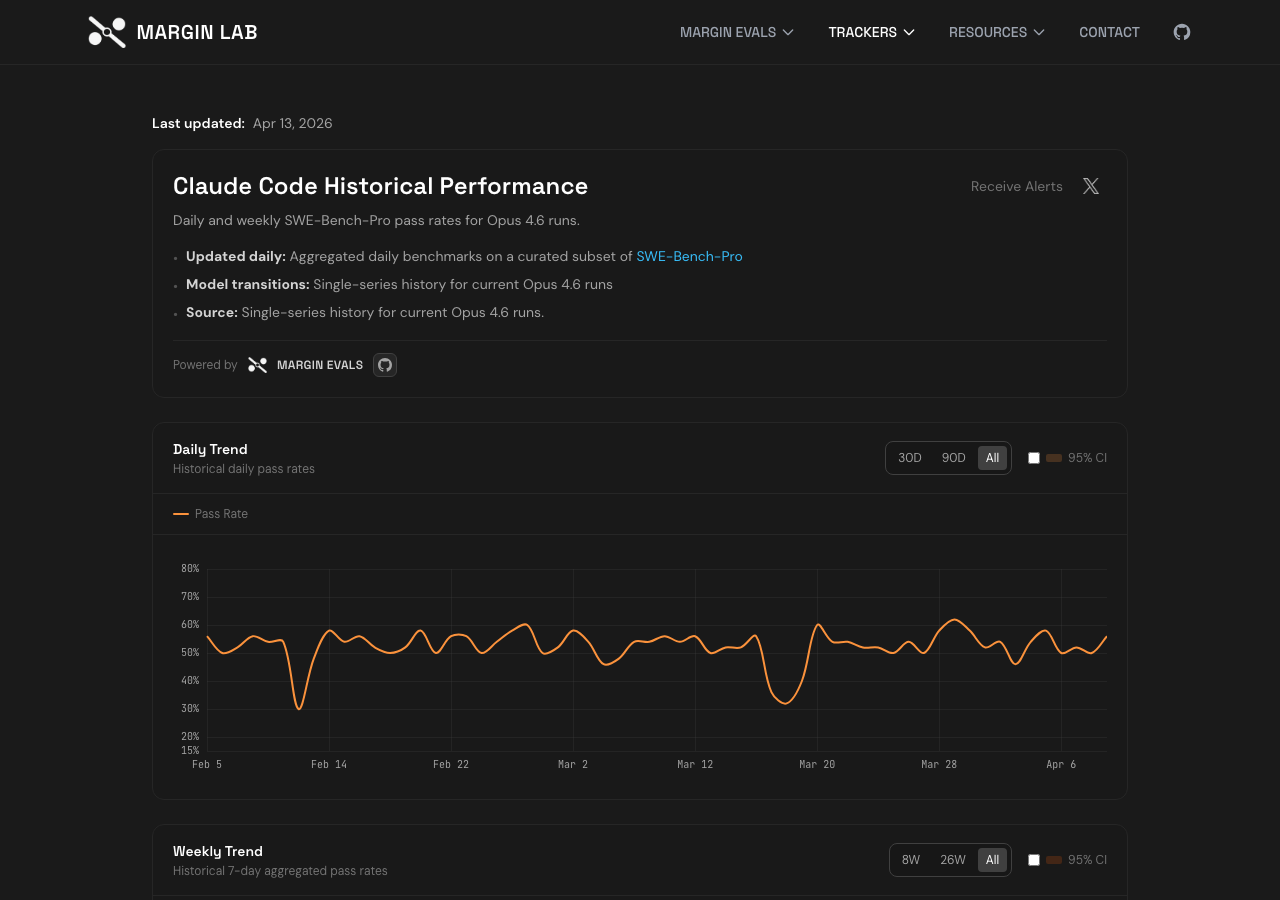
There's a third party called Marginlab that's been running daily SWE-Bench-Pro benchmarks on Claude Code with Opus 4.6, with no Anthropic affiliation. They set up the tracker specifically because independent verification matters when the provider's own reporting is the only alternative. Their baseline pass rate was around 56%, and as of April 10 it had slipped to 50%.
This has happened before, which is the part that makes it hard to extend good faith. Between August and September 2025, Anthropic went through the same cycle. Users reported degradation for weeks. Anthropic said their investigation showed no widespread issues. Then six weeks later they published a postmortem admitting three separate infrastructure bugs had been intermittently degrading quality across their platform.
One routed short-context requests to million-token servers, eventually hitting 16% of Sonnet 4 traffic at peak. Another caused English responses to randomly insert Thai or Chinese characters mid-sentence due to a TPU misconfiguration. A compiler bug in the XLA:TPU stack messed with token probability selection. The postmortem said "We never reduce model quality due to demand, time of day, or server load," which is probably true in the literal sense. But if you're paying $200 a month and the model is getting dumber because of infrastructure bugs nobody caught for six weeks, the distinction between intentional and negligent degradation doesn't really comfort you.
This connects to something I think about a lot as someone building production software on these APIs. Traditional software APIs established an expectation over decades that input produces deterministic output. When that output changes, you get semantic versioning. Version 2.0 is different from 1.9, and you can pin to 1.9 if the new version breaks your workflow. LLMs threw that contract out because the statistical nature of the output gives providers an easy out whenever users complain. You can always wave your hands and say it's just variance.
I think that's exactly what Anthropic was banking on with the recent Opus complaints, and it probably would have worked a few years ago. The problem is that groups like Marginlab exist now, running daily benchmarks, charting pass rates with confidence intervals. "It's just variance" stops working when someone's publishing a graph that says otherwise.
The fix seems straightforward in theory: version your models, ship a new checkpoint, keep the old one available, let people pin and roll back. In practice, hosting multiple versions of a model at Anthropic's scale would require significant additional compute. A hybrid approach where you keep the last couple releases available so customers can track regressions would be a reasonable middle ground. But implementing that requires the company to see itself as a product company with customers rather than a research lab with users, and those two identities lead to very different decisions about where engineering resources go.
The contrast is what gets to me. Anthropic found the resources to coordinate with 40+ companies, brief senior government officials, produce a 244-page system card, launch a $100 million credit program, and generate a solid week of global press coverage for a model that most people will never touch. Meanwhile the model their actual customers depend on has been quietly degrading for weeks, and the best diagnostic tool available to anyone outside the company is an independent benchmark tracker and a pile of Reddit threads.
Mythos isn't fake. The security capabilities seem real enough that Alex Stamos, who previously led security at Facebook and Yahoo, publicly endorsed Glasswing and warned that open-weight models will catch up to frontier models in bug-finding within about six months. But "too dangerous to release" is doing double duty here. It signals responsibility while generating press coverage no advertising budget could buy. The leaked Capybara pricing tells you the restricted access won't last forever once the narrative has done its work. And it conveniently absorbs all the oxygen at exactly the moment when the conversation should have been about why Opus 4.6 is falling apart for the people paying real money to use it.
Cybersecurity expert Claudiu Popa probably captured the duality of this whole thing best when he told BNN Bloomberg: "Many people would be right in saying that this is a little bit of hype, a little bit of press release, a little bit of publicity stunt." He also said the capabilities are still worth taking seriously, and I think he's right on both counts.
Building on AI right now means depending on companies whose competitive incentives push them toward the next big launch rather than quiet maintenance of the existing product. OpenAI has Spud in the pipeline, Google has Gemini 3.1 Pro, and nobody writes headlines about keeping an existing model running reliably. The current customers absorb the cost of that mismatch in ways that are hard to quantify until you're the one staring at a model that used to work and doesn't anymore.
I don't think Anthropic is doing anything uniquely bad. They're doing what the dynamics of this industry push every company toward. But the gap between what they're selling and what they're shipping is getting harder to ignore.
Comments
Join the discussionNo comments yet. Be the first to comment.
